• About CGE

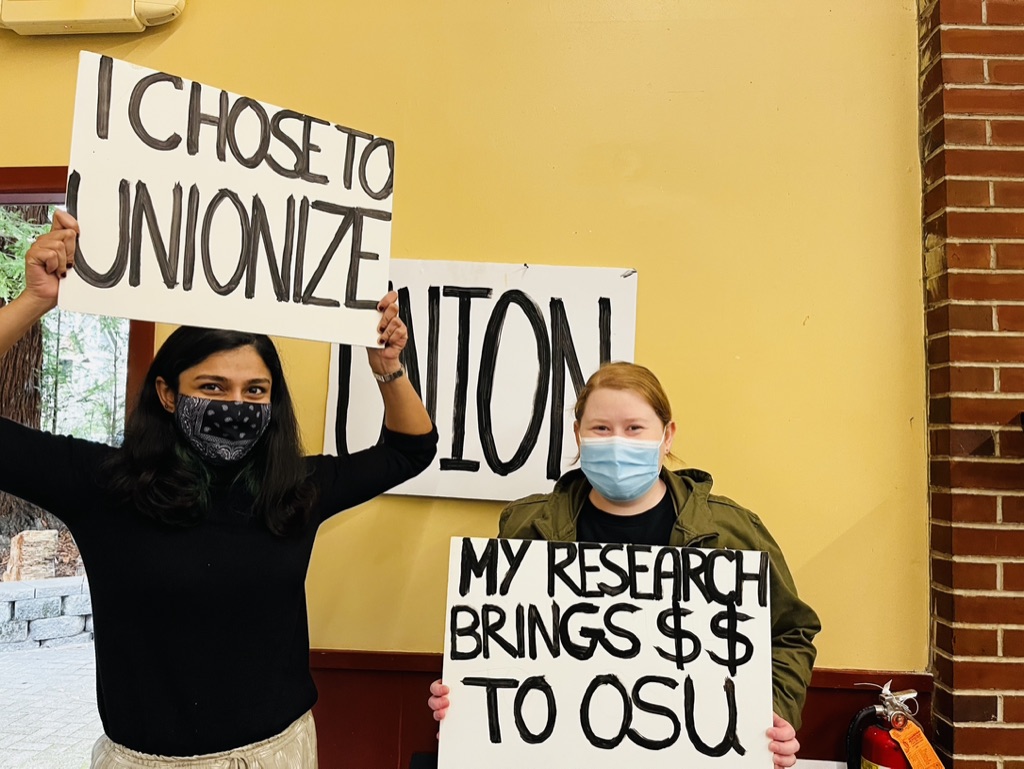
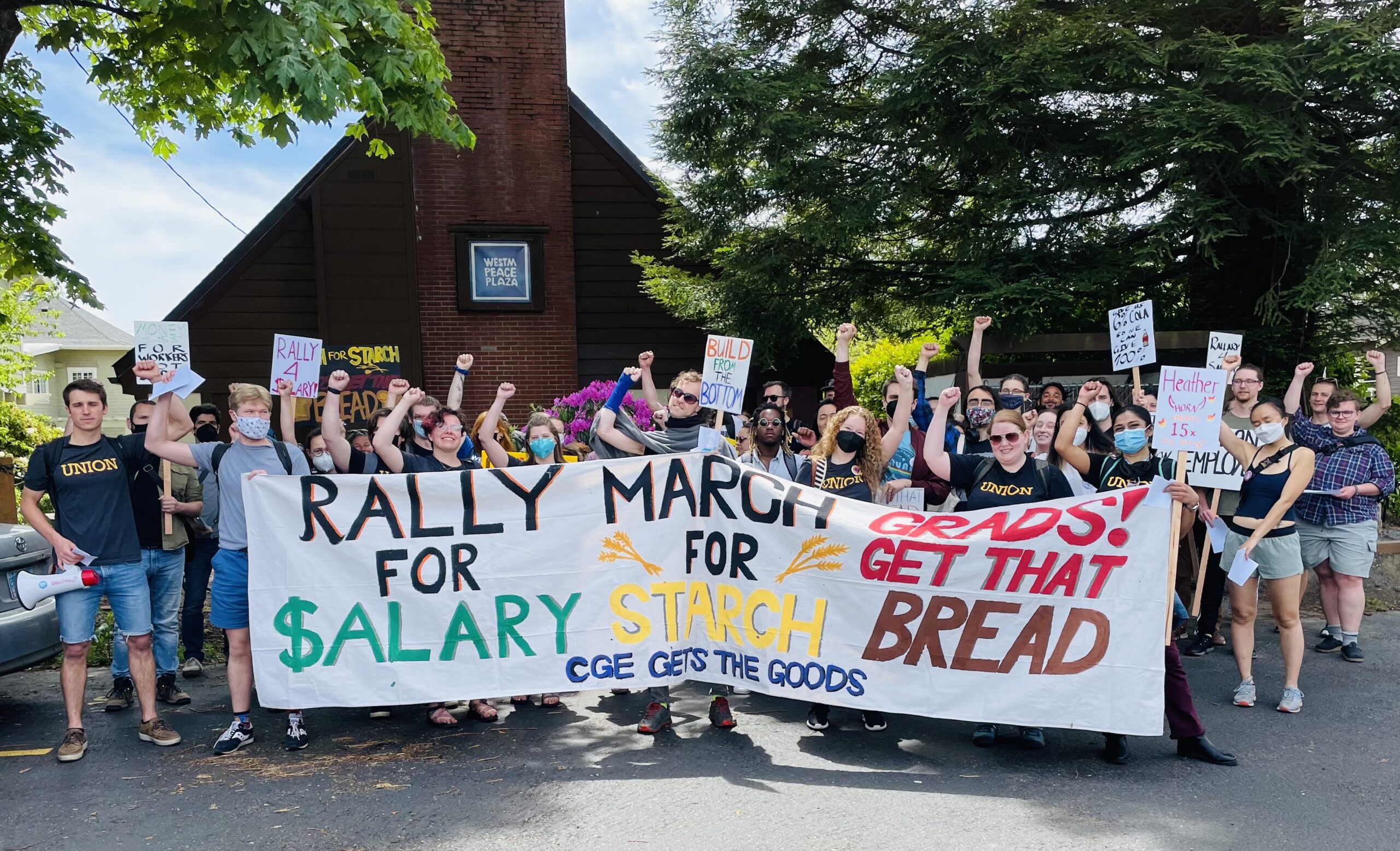
    The Coalition of Graduate Employees (CGE) is the collective voice of the graduate student employees of Oregon State University. CGE is a labor union with the exclusive right to negotiate with OSU on behalf of its Graduate Research and Teaching Assistants. The contracts CGE earns through collective bargaining determine the salary, working conditions, health coverage, and other rights and benefits of employment for the individuals they represent.

    In addition to negotiating our contract, CGE represents OSU's grad assistants in other ways. They have regular discussions with OSU to ensure that we are treated fairly and to ensure that our working conditions are satisfactory, and they have the power to fight to correct unacceptable treatment and conditions.

    As a union, CGE's voice is stronger than the sum of those of the individuals it represents, but its voice becomes even stronger as its membership increases. High membership shows OSU that we grad assistants do care about the way we are treated as employees, and it helps us earn contracts that fairly compensate us for our hard work. So, solitary grad employees of OSU, unite with us, and ensure that your voice is heard. CGE: our union, our voice.


    News

CGE met with the university last Friday, July 16th for the first bargaining session since June 11th.  For those of you who are counting, that’s five weeks between sessions. We’d prefer to meet at least once every week.

We went into the session expecting to hear a full proposal from the university.  Instead, we were informed that the university’s team didn’t have a full proposal ready for us, because they didn’t have enough time to get something ready.  What was missing?  Any mention of minimum salaries or fees, i.e. the two most important topics we are bargaining over.

As you might imagine, the bargaining team and observers were less than impressed, especially since there is zero evidence being offered at these sessions that the administration’s team is actually doing any work outside of the session itself.  When we caucused, several observers made the point that grad employees recognize an unprepared student making excuses, and that’s exactly what the administration’s team sounded like.

When we returned from our caucus, we reiterated our disappointment with their apparent lack of effort.  When we pointed out that five weeks was much longer than the normal time between sessions, and that we were disappointed in their team for not having a full proposal, we were told that their team is busy doing a lot of work on our behalf and that we just need to realize not only how hard they’re working on behalf of graduate employees, but also how hard they try to save jobs for classified staff, ‘many of whom are working full time and trying to support families’ – as if many graduate employees aren’t doing either of those things.

We then moved on to discussing workload issues, which the university was prepared to talk about.  Unfortunately, despite the university agreeing that the proposal that we had made at the previous session was fine and just needed some tweaking, the university brought back the same language they had been proposing for the last four or five sessions, language that was completely different than what we had discussed and agreed upon at the previous session.  (This is what we mean when we say it doesn’t appear the university’s team does any work outside sessions.)

After we expressed our disappointment that the administration apparently didn’t even look at their notes from the last session, we had a very productive exchange with them on specific language around hours worked per week and protections against overwork, and we’re hopeful that we’ll be able to tentatively sign off on some language at the next session and lay workload to rest.  That said, the unprofessionalism and apparent lack of effort on the part of the university’s team has been very disappointing.

The next session is scheduled for Friday, July 30th, at 2 PM somewhere in the Memorial Union.  At that session, we have been told the university will present a proposal on economics, including fees and stipends.  The observer turnout to the meeting on the 16th was truly impressive, considering the length between sessions and the fact that we’re dead in the middle of summer.  In fact, we believe part of the administration’s willingness to engage us on specific language around workload issues at this session was driven by their desire not to look completely bad in front of lots of grad employees.  We hope you all can come to the session on the 30th as well to keep holding the administration accountable.

  • Share/Bookmark

Comments 3 Comments »

2 PM at Westminster House.  The university will be presenting a comprehensive package proposal, so come find out what they have to say!

  • Share/Bookmark

Comments No Comments »

Well, it’s July, and there’s nary a bargaining session in sight.  The university canceled our last planned session, and the next available time they’ve offered us is July 30th – but rest assured that bargaining is still going on.  We’ll keep you posted when something happens, but in the meantime, check out the fun time the GTFF down at UO is having with their bargaining.

  • Share/Bookmark

Comments No Comments »

CGE met with the university for the ninth bargaining session last Friday, June 11th, at 2 PM in the Memorial Union Council Room.

At the end of the previous session, the university’s team had told us to ‘tell us what you need,’ so our proposal was designed to do just that.

Article 12 – Waivers

The State Board of Higher Education, we understand, has voted to eliminate the Registration, Technology and Engineering fees starting next year.  In addition to that, CGE proposed that the Health and Building fees, along with any remaining program-specific fees, be rolled in to tuition.  If this happens, the team is OK with the university’s proposal to eliminate the $300/term in fee relief. However, without all of the above fees disappearing, the loss of the $300 would result in a net loss to grads on fees.  The membership has made clear on several occasions that fee relief is the most important thing for CGE to work on.

When CGE proposed fee relief, the university’s response was to barely acknowledge that we had proposed it and move on quickly.  It’s likely this is going to be a major point of contention and that the university simply didn’t want to engage with 25 observers in the room.

Article 11 – Salary

One point of agreement between CGE and the university has been the worthiness of increasing the minimum salary.  CGE’s initial proposal contained an immediate minimum salary increase that the university has since proposed as well.  In addition, CGE proposed an additional increase to the minimum that would take effect for the 2011-2012 year. Our best guess is that the first minimum increase would affect the bottom 20%, and that the second could affect the bottom third.  Individuals in the Colleges of Liberal Arts and Science would be the most affected.

Article 11 – Workload

In general, CGE is pursuing better contract language around workload limits, so that it is less likely for grads, especially GTAs, to be overworked.  We’re also hoping to provide increased contract protections for what happens when grads do exceed their hours.  The CGE team and the university’s team have gone back and forth about this at some length during bargaining, and we feel we’re getting pretty close to an agreement.  This doc file has a little more info about what we’re proposing and why.

Article 28 – Insurance

CGE proposed that any grad who is employed have 100% of their monthly premium covered, and that grads who take the summer insurance option have 85% of the monthly premium covered, up from the current 85% employed and 50% summer unemployed coverage.  The university’s only response to this was to suggest that since they increased premium coverage two years ago, they could not do so again so soon.

Article 9

This goes on for a bit, so bear with me: The university had been telling us for a few sessions that our proposals around advertising certain open GTA positions were unworkable, and had suggested multiple times that we should be content with seeing the positions advertised in OSU Today.  We had proposed just that, only to be told that no one in the university had the authority to compel departments to send job postings to OSU Today by the same person who told us it would be a good idea.  Then the university, as part of a proposal to us, proposed that HR would send notice once per year to units that they should send job postings to OSU Today.  So at the most recent session, CGE proposed just that – we even went so far as to take the language verbatim from their previous proposal and insert into our own.

Predictably, the university said they couldn’t agree to it. Graciously, they allowed that they made a mistake when proposing that language in the first place.

One thing that was different from previous sessions was that the university chose not to play the “we have no money” card.  While CGE is aware of the state economic forecast and of the overall OSU budget, we are also aware OSU is investing at least $11 million in new infrastructure and potentially a few million more in faculty salaries; because of the new investments, we know the financial situation is more complicated than it might first appear.

Overall, the university had asked us what grads needed, so the CGE team crafted a proposal to answer that question.  When we presented it, the response we were given was a mix of “we won’t” and “we can’t,” with no significant explanation given for either answer.  It’s again disappointing, but not surprising.

The administration team let us know that they would counter our proposal with a complete package at the next session on Friday, June 18, from 2-4:00 pm in the Westminster House.  Their behavior at this past meeting suggested that they plan to do very little to address the needs we brought forth there.  In particular, their coming counterproposal will likely leave in place the ~$185 net loss of fee relief for most grads. The CGE bargaining team will make it clear that we (and you) won’t agree to a contract that wipes out fee relief, but we’ll be much more credible in doing so if you show up to support us, so if you’re around for the summer, please come out to Westminster on Friday.

  • Share/Bookmark

Comments No Comments »

After a three-week hiatus, CGE met with the university’s bargaining team to hear them present a comprehensive proposal.  This was the first time the university had made a comprehensive proposal.

Incidentally, this followed on the heels of an open letter in the Barometer from CGE supporters that include the classified staff, SEIU, and ASOSU, the student government, as well as CGE members handing out fliers to OSU faculty and staff about bargaining the day before.

Without mincing words, the university’s proposal was completely unacceptable to the bargaining team.  The essential parts of their proposal are as follows:  Cutting the $300/term in fee relief, no change to health insurance, and an increase in the minimum salary to match the Graduate School’s recommended minimum.  (The minimum increase is take from CGE’s initial proposal.)

As well, the university let us know that the Oregon University System is rolling the Technology and Registration fees into tuition starting next year, along with the Engineering Fee.  This is a huge positive change for engineers, and will result in about $116/term less in fees for all graduate employees.  However, this is something that is happening outside of bargaining.  It was not actually part of the university’s proposal.

On the whole, the university’s first comprehensive proposal is very regressive for almost everyone.  For people at the bottom, the increase in salary could be a good thing depending on FTE; many grads in the College of Engineering are paid well and will see a huge cut in their fees.  However, for the vast majority of graduate employees, the university’s proposal would result in a significant cut.  The CGE bargaining team’s initial estimate is that it would be a cut of about $800,000 per year across all graduate employees.

On top of the highly regressive proposal, the university’s team managed to contradict themselves multiple times:

When they first presented their proposal, they told CGE that the increases they proposed were designed to offset the cut in the $300; however, after we asked them about it again, they told us it was never designed to totally offset the cuts.  This is in addition to having been clearly told at the beginning of bargaining that the intent of the OSU proposal was to keep the amount of money going to graduate employees the same, but to redistribute it away from fee relief.

The second contradiction occurred when OSU’s lead negotiator first stated that we needed to move quickly, and that they could bring in relevant university officials to answer questions about how specific proposals would impact different units as a way to help move bargaining along; just a few minutes later, we were told that conversations take time, and that we needed to understand that.

The third contradiction was when the university’s team told the CGE team that it was necessary for grads to take cuts in almost the same breath that they told us that some departments are giving 4% raises to their grads.

The fourth contradiction came when the CGE team asked the university to bring the cost estimates they had done and the university refused on the grounds that both sides were working from the same data.  Later in the session, the university’s team told the CGE team that the numbers had changed from those we had shown the university at the beginning of bargaining – i.e. those same numbers the university claimed they were using and that they claimed would be good enough for CGE to use.

It appears that the university’s team is willing to say whatever they think will help them without regard to the truth or consistency with previous statements.  This lack of respect shown the CGE bargaining team has been disappointing, if not surprising.

The CGE team will look at the proposal provided by the university and have a response prepared for the next bargaining session, which is on Friday, June 11th at 2 PM in the Memorial Union Council Room.

  • Share/Bookmark

Comments No Comments »